Media
Stability, Yield, and Scale: Inside ZDR Investments' Record Year
In a recent interview with HN, ZDR Investments leadership — Radek Hladký, Roman Latuske, David Čubr — discussed the group's strongest year on record, large-scale expansion into Austria, and the growing appetite among private investors for retail park assets as an alternative to traditional residential real estate. Selected highlights relevant to international investors are summarised below.
A record year across the platform
The past year was the strongest in ZDR Investments' history. The investment group raised the largest amount of new capital from investors to date and completed its largest volume of acquisitions, particularly in Q4 of last year and Q1 of this year, with significant portfolio expansion in Austria alongside large Czech acquisitions. Substantial work was also completed on lease extensions and ESG initiatives across the existing portfolio.

The strategy itself remains unchanged: a focused approach to retail parks anchored by daily-needs tenants — groceries, drugstores, pet supplies, textiles, and electronics.
This article was originally published in Hospodářské noviny (HN), one of the leading Czech business dailies, and is also available online at hn.cz (in Czech).
Performance and resilience of ZDR Master Fund
ZDR Master Fund is targeting an annual return of eight percent, with lease agreements and underlying assets capable of sustaining this yield over the long term. Resilience has been demonstrated through the inflation clauses embedded in lease agreements, which delivered during the recent high-inflation years in Central Europe.
David Čubr, CEO, explains the source of these returns: "It depends on whether yields move. If they remain the same, the vast majority of the return is generated by rent." In the year-end 2025 valuation, yields barely moved, and property values therefore changed only through rent. "If rent goes up and, at the same yield, a new investor would actually pay more for the property, we consider that healthy and defensible value growth. We don't want to increase valuations just because the market mood is better."
The firm now generates EUR 60 million in annual rental income across a diversified portfolio spanning six European countries. "For us, the main thing is stability," says Roman Latuske. "We will never win rankings with returns above ten percent."
Capital raising and acquisitions
In 2025, ZDR Investments raised nearly EUR 104 million in new capital, with net inflows of approximately EUR 68 million. Investor capital (net asset value) grew by nearly 30 percent. In absolute terms, the firm acquired EUR 200 million worth of assets over the year, financed roughly half from capital raised and half from bank loans.
Liquidity management
Liquidity in ZDR Master Fund remains healthy. The fund operates with a three-year lock-up, meaning investor capital from 2018 has been redeemable for years, and even investors from the 2021 vintage — when nearly EUR 60 million was raised — have been able to redeem for the past two years.
"Within a single year, we paid out EUR 20 million in redemptions on a single fund, which demonstrates a certain strength and size. At the same time, we were able to make acquisitions and hold a reserve," notes Čubr. ZDR Master Fund holds an average liquidity reserve of around five percent.
The fund's settlement record reinforces this discipline: while the statute allows up to six months to settle redemptions, ZDR has settled within one month of NAV publication since inception.
Investor structure
ZDR Investments serves primarily small and mid-sized private investors, with an internal rule that no single investor may hold more than a five percent share. This ensures the firm can at any time satisfy a redemption request, even from its largest investor.
Why Austria
Austria is a core component of ZDR's strategy. "We know that market well, and retail as such has a long tradition there," says Latuske. The team is drawn by the market's high stability and a critical structural feature: greenfield retail development is effectively no longer permitted. "If you have a quality retail park in a good location today, it's hard for any competition to emerge nearby."
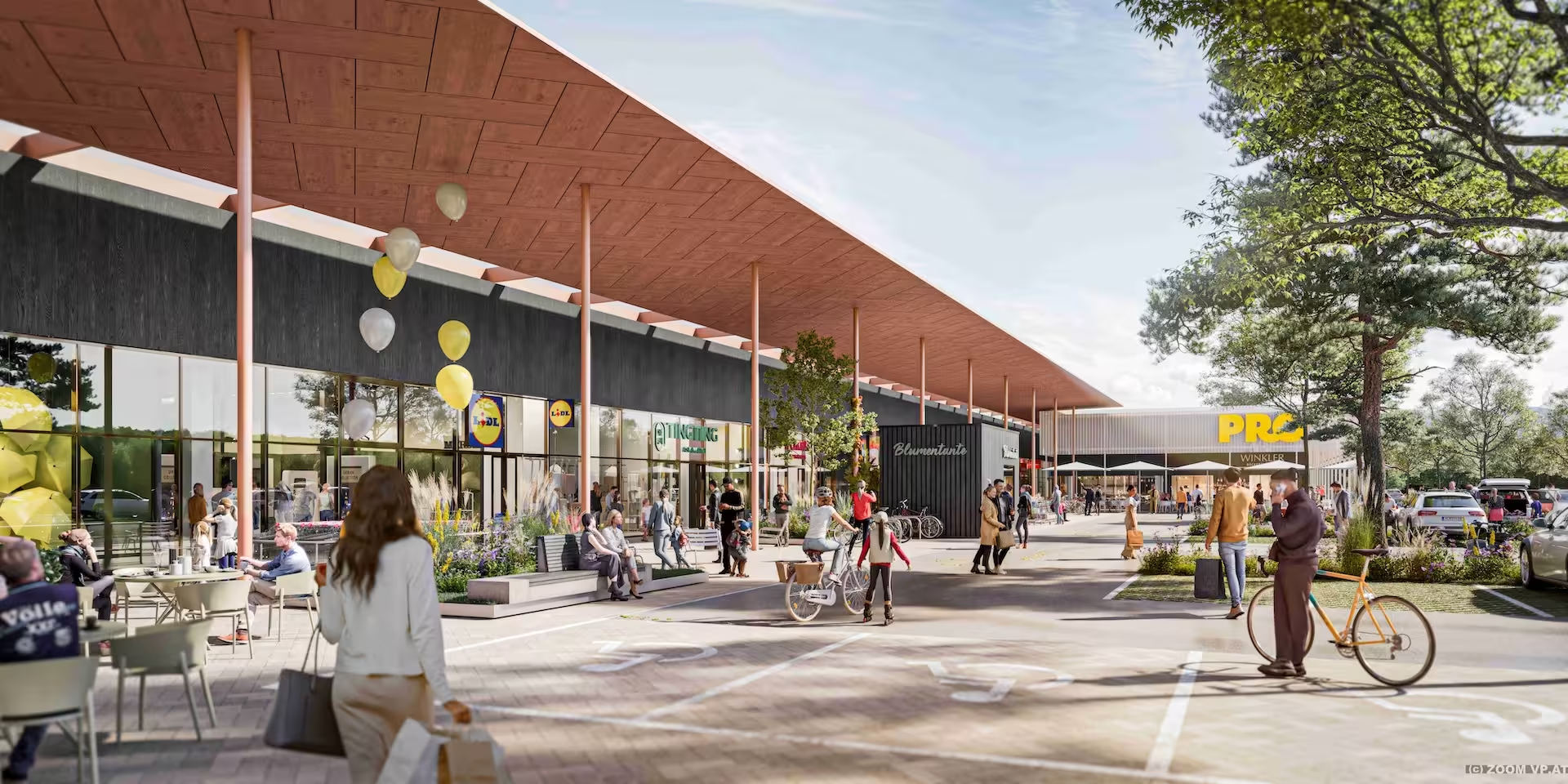
A current example is a shopping centre in Linz, which ZDR will take over at the beginning of 2027 following refurbishment. A traditional 1970s shopping centre is being substantially rebuilt on a long-established retail site, retaining roughly 300 outdoor parking spaces and the retail park format. "The property stands on a site where a large shopping centre already stood, so locals are used to shopping there," explains Hladký.
Capital "recycling"
ZDR Investments is also considering selective disposals. Properties acquired in 2018 and 2019 are now approaching eight years of operation, presenting a choice between further capex investment ("greening," structural elements, roof, façade) or sale into a liquid market. "Especially with a lot of liquidity in the market right now, it's better to sell the product — particularly if the rent is well set, lease maturities are long, the tenant mix is good, and the location is good," says Latuske. Capital can then be recycled into larger Austrian properties when attractive opportunities arise. Disposal candidates are likely to be the smaller properties acquired in the early years, which carry similar management overhead to larger assets and offer efficiency gains when divested.
Why retail parks appeal to private investors
A growing trend across Central Europe — and increasingly visible in Austria — is private investors, family offices, and private foundations allocating to retail parks as an alternative to apartment buildings. "If you don't use bank financing, then especially in good locations of large cities with good transport access, the yield on apartment buildings is very low — around three to 3.5 percent net. So when buying with their own money, it makes much more sense to buy a retail park yielding 6.5 to 7 percent. And if they're bolder and bring a bank into the deal, it can easily yield ten percent," explains Latuske. "That works out better than a residential portfolio, typically with lower management intensity."
Label
Let your capital work for you in real estate across Europe
1
Leave us contact
2
We’ll get in touch and guide you through the steps
3
Start earning with your investment
We will contact you as soon as possible and together we will choose the best way to invest.
